Some of the Bible’s biggest moments happen on mountains. Noah’s ark comes to rest on the mountains of Ararat. Abraham climbs a mountain in the land of Moriah with Isaac. Moses meets God at Horeb, receives the law on Sinai, and looks over the promised land from Nebo. Elijah calls down fire on Carmel. Jesus teaches, prays, is transfigured, and gives his final instructions on mountains, and he goes to the Mount of Olives on the night he is betrayed.
Mountains don’t carry one fixed meaning everywhere they appear. This guide walks through the main mountains of the Bible, what the key verses actually say, and how mountains work as images in the Psalms and the prophets.
The quotations below are from the King James Version, a public-domain English translation, checked against a public KJV text in November 2026. The KJV sometimes spells names differently from modern translations (for example, “Sion” for Zion in Hebrews 12:22 and “Elias” for Elijah in the Gospels).
What do mountains symbolize in the Bible?
Mountains in Scripture are real places first, but a few patterns recur:
- Places where God meets people. Horeb is called “the mountain of God” (Exodus 3:1), and the Lord comes down on Sinai “in fire” (Exodus 19:18).
- Pictures of strength and permanence. “Thy righteousness is like the great mountains” (Psalm 36:6).
- Pictures of obstacles. Jesus speaks of faith that can say to a mountain, “Remove hence to yonder place” (Matthew 17:20), and the prophets speak of every mountain being “made low” (Isaiah 40:4).
- The future reign of God. Isaiah and Micah both picture “the mountain of the LORD’S house” raised above every other mountain (Isaiah 2:2; Micah 4:1).
Mountains of the Bible at a glance
| Mountain (KJV name) | Key passages | What happens there |
|---|---|---|
| Ararat | Genesis 8:4-5 | The ark comes to rest after the flood |
| Moriah | Genesis 22:2, 13-14; 2 Chronicles 3:1 | Abraham offers the ram in place of Isaac; Solomon later builds the temple there |
| Horeb / Sinai | Exodus 3:1-5; Exodus 19:18-20; Exodus 24:18; Exodus 31:18; 1 Kings 19:8-12 | The burning bush; the giving of the law; Elijah hears “a still small voice” |
| Gerizim and Ebal | Deuteronomy 11:29; Deuteronomy 27:12-13; John 4:20-23 | The blessing and the curse; the Samaritan woman’s question about worship |
| Nebo / Pisgah | Deuteronomy 34:1-5 | Moses sees the promised land and dies in Moab |
| Carmel | 1 Kings 18:19-39 | Elijah and the prophets of Baal |
| Zion | 2 Samuel 5:7; Psalm 2:6; Psalm 48:2; Hebrews 12:22 | The city of David; God’s chosen king; the heavenly Jerusalem |
| Hermon and Tabor | Psalm 133:3; Judges 4:6 | The dew of Hermon as a picture of blessing; Barak gathers his army at Tabor |
| Mount of Olives | Matthew 24:3; Matthew 26:30, 36; Luke 22:39; Acts 1:9-12; Zechariah 14:4 | Jesus’ teaching on the end of the age; the night before the cross; the ascension; a prophecy of the day of the Lord |
Mount Ararat: where the ark rested
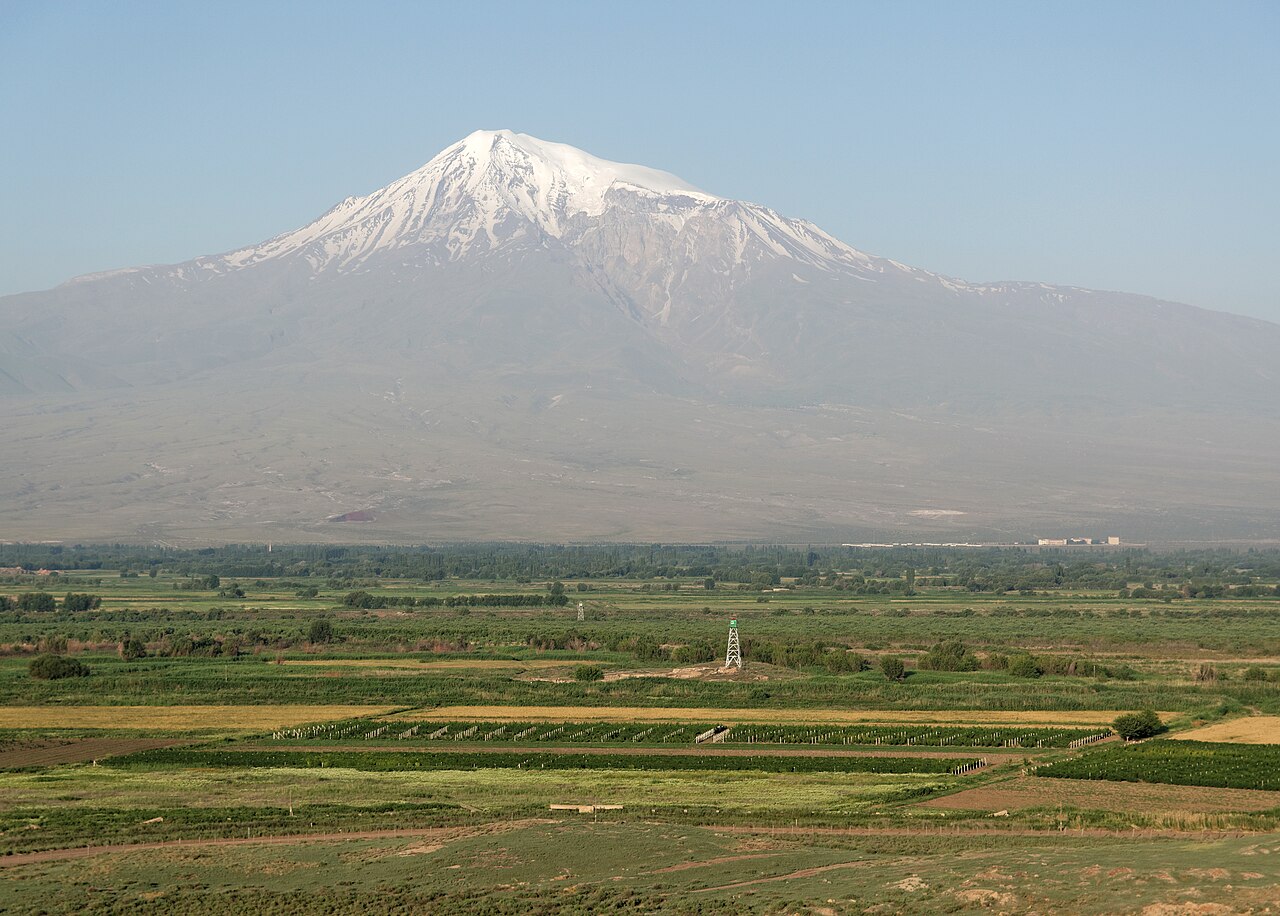
The first mountain named in the Bible appears at the end of the flood: “And the ark rested in the seventh month, on the seventeenth day of the month, upon the mountains of Ararat” (Genesis 8:4). A few verses later, “were the tops of the mountains seen” (Genesis 8:5).
Notice the plural. Genesis says “the mountains of Ararat,” pointing to a mountainous region rather than naming a single peak. The tall volcano known today as Mount Ararat, in eastern Turkey near the Armenian border, takes its name from that region. In the story, they are the first solid ground after the flood, where the earth gets a new start.
Mount Moriah: “In the mount of the LORD it shall be seen”
God tells Abraham, “Take now thy son, thine only son Isaac, whom thou lovest, and get thee into the land of Moriah; and offer him there for a burnt offering upon one of the mountains which I will tell thee of” (Genesis 22:2). At the last moment, Abraham sees “a ram caught in a thicket by his horns” and offers it “in the stead of his son” (Genesis 22:13).
Abraham names the place, and Genesis adds a saying that was still in use when it was written: “In the mount of the LORD it shall be seen” (Genesis 22:14). Centuries later, 2 Chronicles 3:1 says Solomon built the temple “at Jerusalem in mount Moriah.” So the mountain where God provided a substitute for Isaac became the place where Israel offered sacrifices.
Mount Sinai (Horeb): the mountain of God
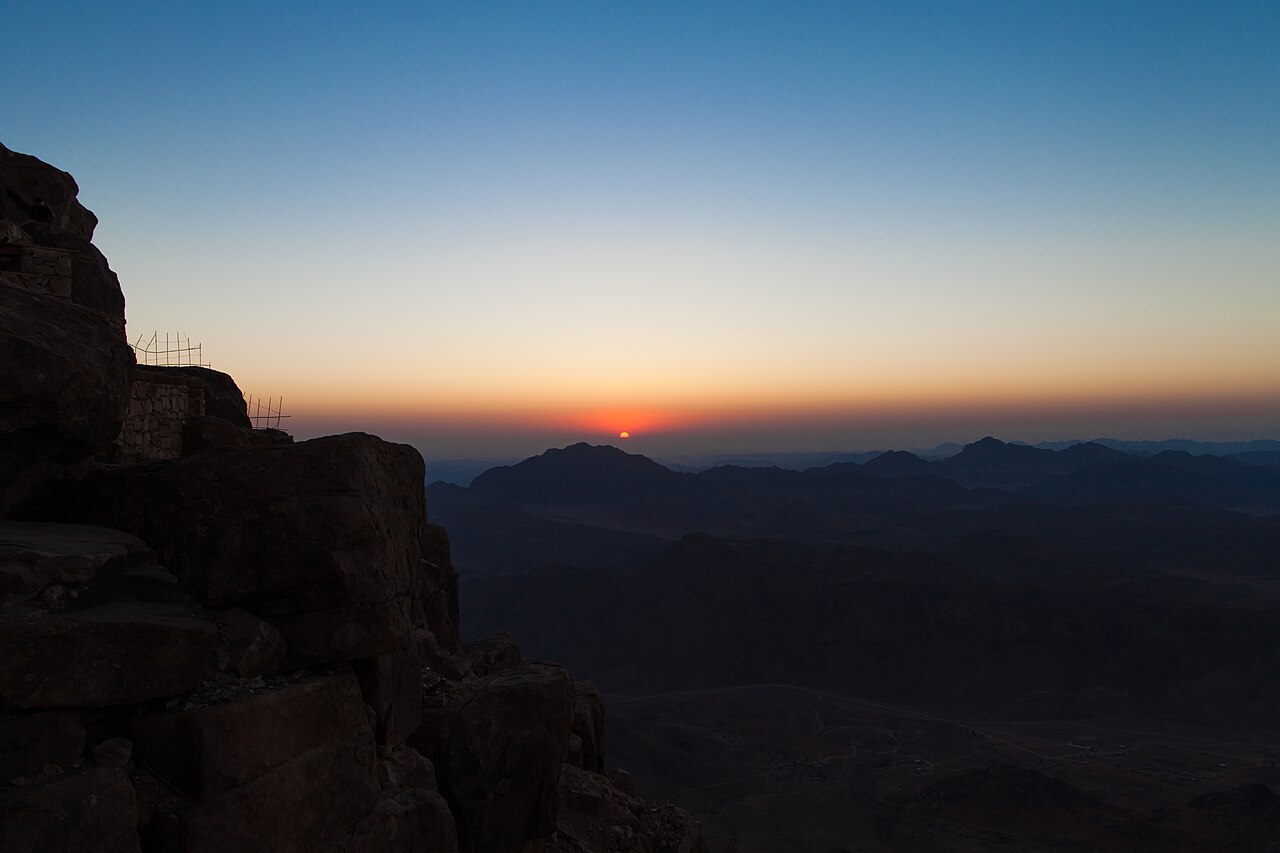
Scripture uses two names for this mountain, Sinai and Horeb, and both appear in some of the most important scenes in the Old Testament. The traditional site is Jebel Musa in Egypt’s southern Sinai Peninsula (shown in this post’s featured image), though scholars still debate the mountain’s exact location.
The burning bush at Horeb
Moses is keeping Jethro’s flock when he “came to the mountain of God, even to Horeb” (Exodus 3:1). There God speaks from the burning bush and tells him, “put off thy shoes from off thy feet, for the place whereon thou standest is holy ground” (Exodus 3:5).
The law given at Sinai
After the exodus, Israel “camped before the mount” (Exodus 19:2). Then “mount Sinai was altogether on a smoke, because the LORD descended upon it in fire: and the smoke thereof ascended as the smoke of a furnace, and the whole mount quaked greatly” (Exodus 19:18). The Lord calls Moses “up to the top of the mount” (Exodus 19:20). The Ten Commandments follow in Exodus 20.
Moses later stays “in the mount forty days and forty nights” (Exodus 24:18), and God gives him “two tables of testimony, tables of stone, written with the finger of God” (Exodus 31:18). (For more, see Understanding the Ten Commandments.)
Elijah and the still small voice
Generations later, a worn-out Elijah walks “forty days and forty nights unto Horeb the mount of God” (1 Kings 19:8). There the Lord passes by. A strong wind tears at the mountains, “but the LORD was not in the wind,” then an earthquake and a fire, and “after the fire a still small voice” (1 Kings 19:11-12). The mountain of fire and smoke from Moses’ day becomes the place where Elijah learns that God does not always come in the dramatic way he expects.
Mount Gerizim and Mount Ebal: blessing and curse
Before Israel enters Canaan, Moses tells them, “thou shalt put the blessing upon mount Gerizim, and the curse upon mount Ebal” (Deuteronomy 11:29). Deuteronomy 27:12-13 assigns six tribes to stand on each mountain.
Gerizim comes up again in John 4. The woman of Samaria tells Jesus, “Our fathers worshipped in this mountain; and ye say, that in Jerusalem is the place where men ought to worship” (John 4:20). Jesus answers that “the true worshippers shall worship the Father in spirit and in truth” (John 4:21-23), not on one particular mountain.
Mount Nebo: Moses sees the promised land
At the end of his life, “Moses went up from the plains of Moab unto the mountain of Nebo, to the top of Pisgah, that is over against Jericho. And the LORD shewed him all the land” (Deuteronomy 34:1). God tells him, “I have caused thee to see it with thine eyes, but thou shalt not go over thither” (Deuteronomy 34:4), and “Moses the servant of the LORD died there in the land of Moab” (Deuteronomy 34:5).
Nebo is a mountain of seeing without entering: God keeps his promise even as Moses stops at the border. To trace the whole arc of his life, see How To Study The Life Of Moses In The Bible.
Mount Carmel: Elijah and the prophets of Baal
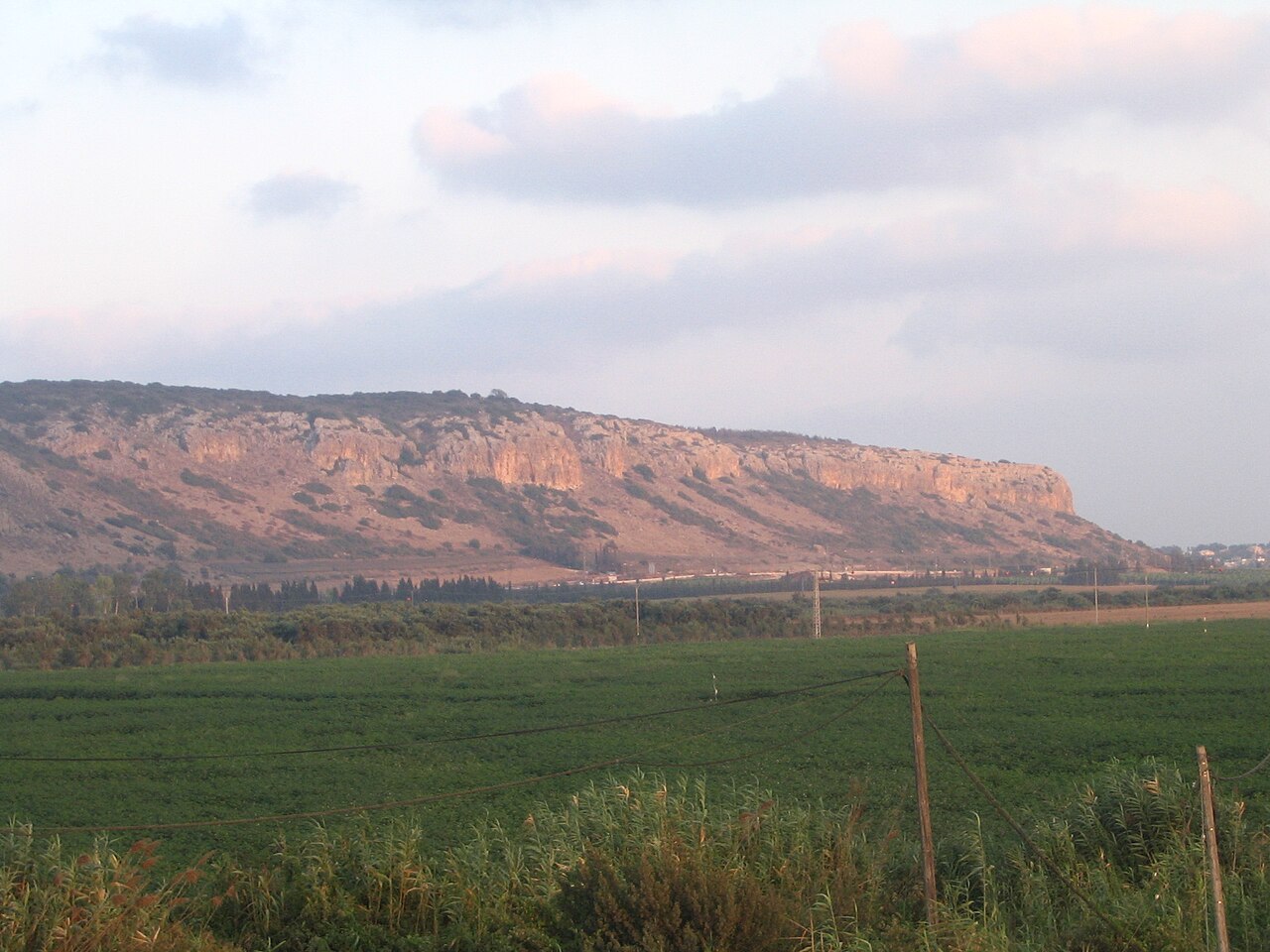
Carmel is a ridge near the Mediterranean coast in northern Israel, above the modern city of Haifa. In 1 Kings 18, Elijah tells King Ahab to “gather to me all Israel unto mount Carmel, and the prophets of Baal four hundred and fifty” (1 Kings 18:19).
Before the contest, he confronts the people: “How long halt ye between two opinions? if the LORD be God, follow him: but if Baal, then follow him. And the people answered him not a word” (1 Kings 18:21). After the prophets of Baal call out all day with no answer, “the fire of the LORD fell, and consumed the burnt sacrifice,” and the people cry, “The LORD, he is the God; the LORD, he is the God” (1 Kings 18:38-39). Carmel is the mountain of decision, where Israel has to stop limping between two loyalties.
Mount Zion: the city of David and the heavenly Jerusalem
Zion begins as a fortress. “David took the strong hold of Zion: the same is the city of David” (2 Samuel 5:7). From there the name grows to stand for Jerusalem and the place where God dwells among his people. The psalmist calls it “Beautiful for situation, the joy of the whole earth, is mount Zion” (Psalm 48:2), and God says of his chosen king, “Yet have I set my king upon my holy hill of Zion” (Psalm 2:6).
The New Testament carries the image forward. Hebrews contrasts Sinai, “the mount that might be touched, and that burned with fire” (Hebrews 12:18), with something better: “But ye are come unto mount Sion, and unto the city of the living God, the heavenly Jerusalem” (Hebrews 12:22). For believers, Zion pictures the welcome access to God that comes through Christ.
Mount Hermon and Mount Tabor
Hermon, a high mountain in the far north often capped with snow, shows up in one of the best-loved psalms about unity. Brothers dwelling together in unity are “As the dew of Hermon, and as the dew that descended upon the mountains of Zion: for there the LORD commanded the blessing, even life for evermore” (Psalm 133:3).
Tabor rises from the plain in Galilee. In Judges 4:6, Deborah tells Barak, “Go and draw toward mount Tabor, and take with thee ten thousand men,” and from there Israel goes down to defeat Sisera’s army.
Mountains in the life of Jesus
The Sermon on the Mount
In the wilderness, the devil takes Jesus up “an exceeding high mountain” to offer him the kingdoms of the world (Matthew 4:8). Soon after, “seeing the multitudes, he went up into a mountain: and when he was set, his disciples came unto him” (Matthew 5:1). He begins the Sermon on the Mount. To go deeper into that sermon, see Exploring the Sermon on the Mount.
The Mount of Transfiguration
Jesus takes Peter, James, and John “up into an high mountain apart, And was transfigured before them: and his face did shine as the sun, and his raiment was white as the light” (Matthew 17:1-2). “Moses and Elias” appear with him (Matthew 17:3), the two great figures of Sinai and Horeb, and a voice from the cloud says, “This is my beloved Son, in whom I am well pleased; hear ye him” (Matthew 17:5). Peter later calls it “the holy mount” (2 Peter 1:18).
The Gospels do not name this mountain. Church tradition has long pointed to Mount Tabor, while others suggest Mount Hermon because the previous scene takes place near Caesarea Philippi (Matthew 16:13).
The Mount of Olives
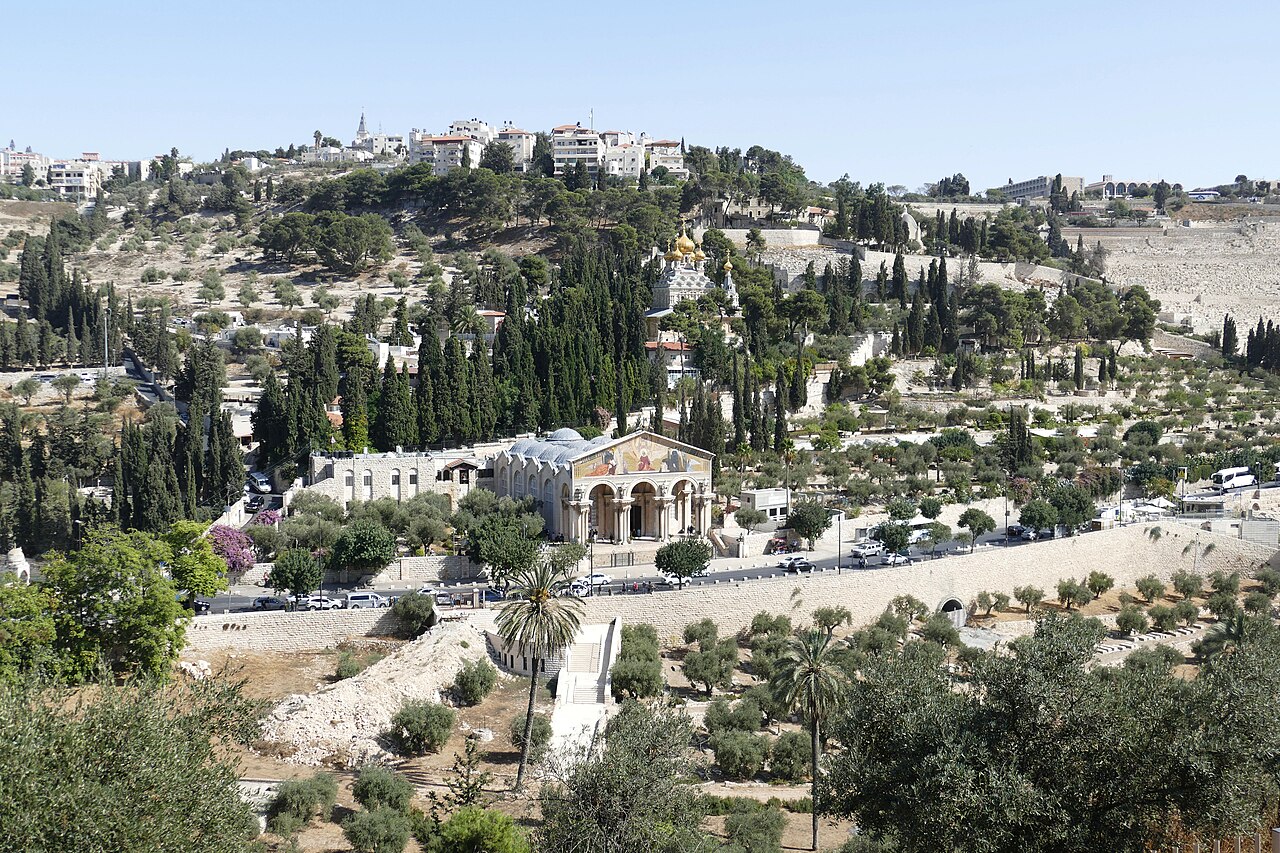
The Mount of Olives sits just east of Jerusalem, across the Kidron Valley. Jesus sits there when the disciples ask him, “Tell us, when shall these things be? and what shall be the sign of thy coming, and of the end of the world?” (Matthew 24:3). On his last night, after the Passover meal, “they went out into the mount of Olives” (Matthew 26:30), to “a place called Gethsemane” (Matthew 26:36).
After the resurrection, Jesus is taken up into heaven, and the disciples return to Jerusalem “from the mount called Olivet” (Acts 1:9-12). Long before, Zechariah had prophesied that in the day of the Lord “his feet shall stand in that day upon the mount of Olives, which is before Jerusalem on the east” (Zechariah 14:4).
Golgotha and the final mountain in Matthew
The Gospels call Golgotha “a place called the place of a skull” (John 19:17), not a mountain. But Matthew’s Gospel does end on one: after the resurrection, “the eleven disciples went away into Galilee, into a mountain where Jesus had appointed them” (Matthew 28:16), and there he gives the Great Commission.
Mountains as images in the Psalms and the prophets
“I will lift up mine eyes unto the hills”
Psalm 121 opens, “I will lift up mine eyes unto the hills, from whence cometh my help. My help cometh from the LORD, which made heaven and earth” (Psalm 121:1-2). The psalmist looks toward the hills, but his help comes from the God who made them.
Steadier than the mountains
Mountains seem permanent, but Scripture says God is older (Psalm 90:2) and his kindness steadier: “For the mountains shall depart, and the hills be removed; but my kindness shall not depart from thee, neither shall the covenant of my peace be removed, saith the LORD that hath mercy on thee” (Isaiah 54:10).
The mountain of the LORD’s house
Isaiah and Micah share a vision of the last days: “the mountain of the LORD’S house shall be established in the top of the mountains, and shall be exalted above the hills; and all nations shall flow unto it” (Isaiah 2:2; compare Micah 4:1). The nations go up to learn God’s ways, and “they shall beat their swords into plowshares” (Isaiah 2:4).
Every mountain made low
Isaiah 40:4 announces, “Every valley shall be exalted, and every mountain and hill shall be made low: and the crooked shall be made straight, and the rough places plain.” Luke 3:5 applies these words to the ministry of John the Baptist, who prepared the way for Jesus.
Faith that moves mountains
Jesus tells his disciples, “If ye have faith as a grain of mustard seed, ye shall say unto this mountain, Remove hence to yonder place; and it shall remove; and nothing shall be impossible unto you” (Matthew 17:20; see also Mark 11:23). The mountain pictures an obstacle that looks immovable; small but real faith in God is enough.
How to read mountain symbolism without stretching the text
- Start with the place. Most mountains in the Bible are real locations. Read the story first, then look for a symbol.
- Let the passage set the meaning. Sinai is about covenant; Carmel is about choosing whom to serve; the Psalms’ mountains are about God’s faithfulness.
- Be careful with locations. The exact sites of Sinai and the transfiguration are debated.
- Remember that God is not limited to mountains. True worship is “in spirit and in truth” (John 4:23).
Related studies on BibleLift
- Trees in the Bible and Their Meaning: A Verse Guide
- Birds in the Bible and Their Meaning: A Verse Guide
- Exploring the Symbolism of Numbers in the Bible
- Exploring the Sermon on the Mount
FAQ
What do mountains symbolize in the Bible?
It depends on the passage. Mountains are often places where God meets people, like Horeb, “the mountain of God” (Exodus 3:1), and Sinai, where the law was given (Exodus 19). In poetry they picture strength and permanence (Psalm 36:6; Psalm 125:2), and in Jesus’ teaching they picture obstacles that faith can overcome (Matthew 17:20). The prophets also use “the mountain of the LORD’S house” as a picture of God’s coming reign (Isaiah 2:2).
On which mountain did Noah’s ark land?
Genesis 8:4 says the ark rested “upon the mountains of Ararat.” The plural points to a mountainous region rather than one named peak, so Scripture does not identify the exact mountain.
What happened on the Mount of Olives?
Jesus taught there about the end of the age (Matthew 24:3), went there to Gethsemane on his last night (Matthew 26:30, 36), and ascended to heaven from there (Acts 1:9-12).
Where did the transfiguration happen?
Matthew 17:1 says only that Jesus took Peter, James, and John “up into an high mountain apart.” The Gospels do not name it. Tradition points to Mount Tabor, and some suggest Mount Hermon, but the text leaves it unnamed.
Image credits: Featured image: sunrise from Mount Sinai (Jebel Musa) by Grand Parc – Bordeaux, France, CC BY 2.0, via Wikimedia Commons. Mount Ararat by © Vyacheslav Argenberg, CC BY 4.0, via Wikimedia Commons. Mount Carmel by Chadner, public domain, via Wikimedia Commons. Mount of Olives by Bukvoed, CC BY 4.0, via Wikimedia Commons.